


Individual Coverage HRA (ICHRA)
A Flexible Alternative to Traditional Group Health Insurance
For many employers, offering health insurance has traditionally meant choosing one or more group health plans and asking employees to enroll in those options.
An Individual Coverage Health Reimbursement Arrangement, commonly called an ICHRA, provides another way to offer health benefits.
Instead of purchasing one traditional group health insurance plan for everyone, an employer can provide eligible employees with a defined amount of money that can be used to reimburse the cost of their own individual health insurance coverage and, depending on how the arrangement is designed, other eligible medical expenses.
For the right business, an ICHRA can provide greater cost predictability for the employer while giving employees more flexibility in choosing their health insurance.
At Nexus Insurance Advisors, we help employers understand the differences between traditional group health plans and alternative strategies such as ICHRAs so they can determine which approach makes the most sense for their business and employees.
What Is an ICHRA?
An Individual Coverage Health Reimbursement Arrangement (ICHRA) is an employer-funded health benefit that allows a business to reimburse eligible employees for individual health insurance premiums and other qualified medical expenses, depending on the design of the arrangement.
Rather than the employer choosing a single insurance carrier or group health plan, employees generally purchase qualifying individual health insurance coverage that meets their own needs. The employer then reimburses eligible expenses up to the allowance established by the company.
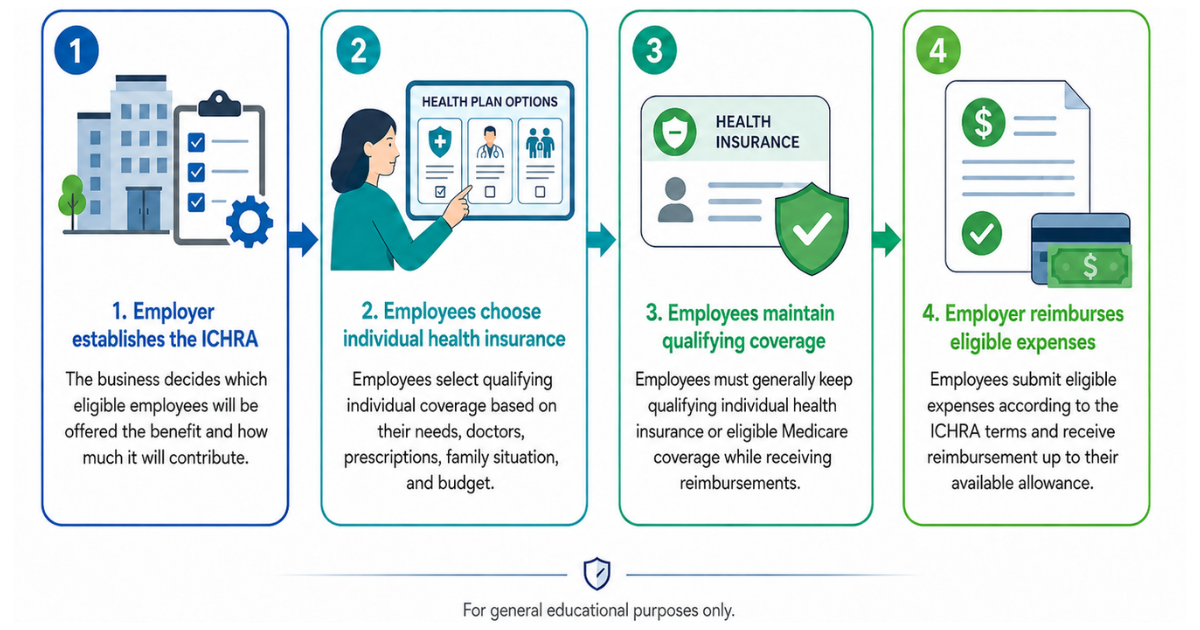
The basic process looks like this:
1. The employer establishes the ICHRA.
The business determines which eligible employees will be offered the benefit and how much it will contribute.
2. Employees choose individual health insurance.
Eligible employees select qualifying individual health coverage based on their own needs, doctors, prescriptions, family situation and budget.

3. Employees maintain qualifying coverage.
Employees participating in the ICHRA must generally maintain qualifying individual health insurance coverage or eligible Medicare coverage while receiving reimbursements.
4. The employer reimburses eligible expenses.
Employees submit eligible expenses according to the terms of the ICHRA and receive reimbursement up to their available allowance.
The result is a defined-contribution approach to health benefits: instead of committing to a particular group insurance plan, the employer can establish a health benefit budget and allow employees greater flexibility in how they use it.
Benefits of Offering an ICHRA
ICHRAs can provide several advantages for employers and employees. Whether those advantages outweigh traditional group health insurance depends on the company, workforce and individual insurance market available to employees.
More Predictable Employer Costs
With a traditional group health plan, employers can experience premium increases from year to year.
An ICHRA allows an employer to establish how much it is willing to make available toward employee health benefits. This can create greater predictability when budgeting for healthcare expenses.
More Choice for Employees
Employees are not necessarily limited to one or two plans selected by their employer.
Instead, they can shop for individual health insurance and choose coverage based on factors such as:
Monthly premium
Deductible
Copays
Prescription coverage
Provider networks
Preferred doctors and hospitals
Coverage needs for family members
This can be especially attractive for a workforce where employees have very different healthcare needs.
Flexibility for Employers
Employers can design an ICHRA differently for certain permitted classes of employees, subject to federal requirements.
For example, federal ICHRA rules recognize employee classifications that can include distinctions such as full-time versus part-time employees, salaried versus non-salaried employees, and certain geographic classifications. Special rules apply when an employer offers a traditional group health plan to one employee class and an ICHRA to another.
This flexibility can make ICHRAs worth exploring for businesses with diverse workforces.
A Potential Solution for Multi-State Employers
Traditional group health insurance can become more complicated when employees live in different states or geographic areas.
Because ICHRA participants purchase individual coverage available where they live, an ICHRA may provide another option for employers with employees located across multiple geographic markets.
Tax-Advantaged Health Benefits
When properly established and administered, an ICHRA allows employers to reimburse eligible employees for qualifying healthcare expenses on a tax-advantaged basis.
See If an ICHRA Is Right for Your Business
Not sure whether an ICHRA or traditional group health insurance is the better fit? Complete the form below and a Nexus Insurance Advisors benefits specialist will help you compare your options and determine what makes sense for your business and employees.